
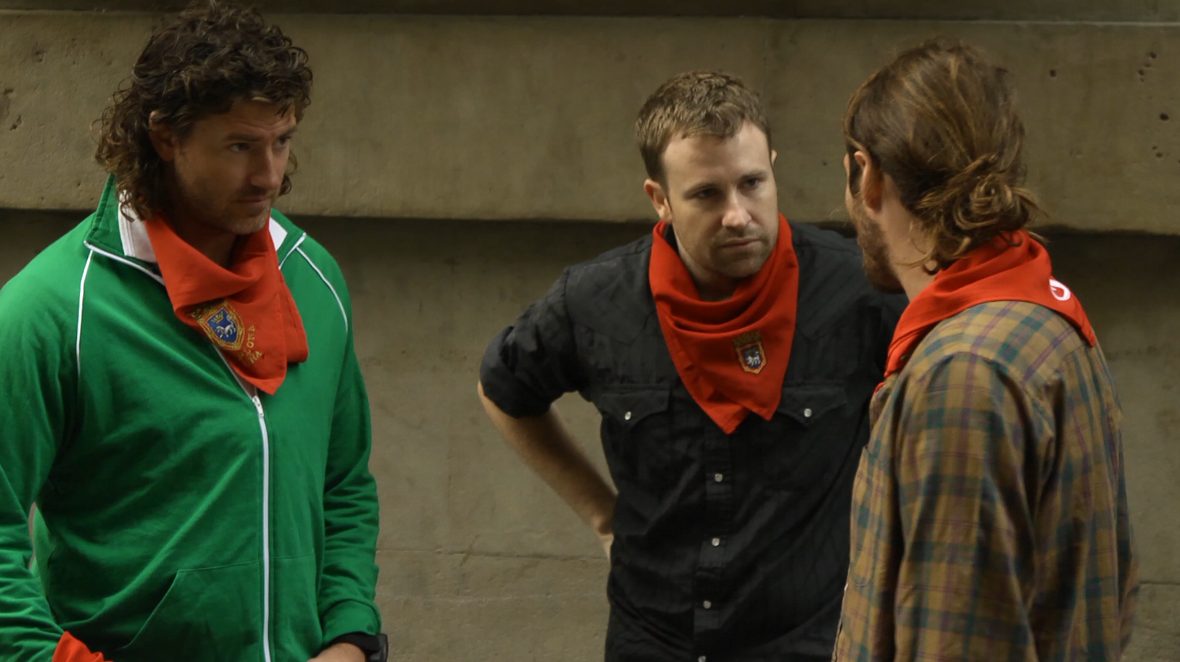
The Chasing Red documentary took eight years to make, from a first interview in Pamplona in July 2007 to its release in 2015. Most of that time went into learning the run and the fiesta. The film itself was shot over the eight runs of San Fermín 2012, by a small crew who used their own cameras and were paid in food, lodging and the fiesta.
This is the record of how it was made, told by Dennis Clancey, who directed the film and ran in it, and checked against what was reported at the time. What the film is about is covered in What is Chasing Red?; this page is about how it got made.
Key facts
- First footage: an interview with the author Ray Mouton, 8 a.m., July 6, 2007.
- Research: 2007 to 2011, in Pamplona and on two bull ranches in southern Spain, paid for by the director.
- Teaser: shot in Pamplona in 2011 by Brandon Widener and two other camera operators.
- Principal photography: the eight runs of San Fermín, July 7 to 14, 2012.
- Edit: by Brian Moghari, in a shared studio in the Arts District of Los Angeles.
- Released: premiered in 2015, with a limited theatrical run in the United States and a screening in Mexico City.
The first thing filmed in Pamplona
The first thing Dennis filmed in Pamplona was an interview with the author Ray Mouton, at 8 a.m. on July 6, 2007, just before his first Chupinazo, the rocket that opens San Fermín. Mouton wrote Pamplona: Running the Bulls, Bars and Barrios in Fiesta de San Fermin, published in 2002 and still in print. Dennis says the book shaped his early opinions of the ideal of the fiesta.
That first year was about experiencing the fiesta. Dennis watched the run from a balcony, then ran for the first time the next day. He also interviewed a few runners and authors in town. He had already started talking about making a documentary.
Research, 2008 to 2011
The research years were self-funded. Travel Edits, which interviewed Dennis around 2013, reported that he paid for 2007 to 2011 himself, and that the research took in officials, breeders, priests and runners as well as the writing of Hemingway and Michener.
In 2008 he started digging into everything around the run. He spent time in Sevilla, and visited the ranches of Fuente Ymbro and Cebada Gago, two bull breeding ranches in the province of Cádiz whose bulls run regularly in Pamplona. He met the ganaderos, the breeders, and studied where the bulls are raised. Encierro, the company Dennis founded, has histories of both ranches: Fuente Ymbro and Cebada Gago.
In Pamplona in 2008 he conducted more interviews and hired a cameraman who stayed for the whole fiesta. The crew had press passes and began filming the runs.
In 2009 the aim changed, from learning the fiesta to finding a story in it.
“In 2009, I went back with the intent to find my story in Fiesta. So go, enjoy the Fiesta, and see what stories presented themselves.”
Dennis Clancey
Part of the research was watching what had already been made. Dennis tracked down the earlier documentaries about the run, including Ivor Bowen’s, which he found on VHS through a university library. They are reviewed in Running of the bulls documentaries. He also filmed the procession of San Fermín as research.
The 2011 teaser and Brandon Widener
By 2011 there was still no film.
“So much of Chasing Red was made on a shoestring budget. I had started talking about this documentary that I wanted to do in 2007, and it was 2011. We hadn’t made it yet, and I’m still searching for exactly how we might capture it, and how logistically we might make a very complex production in Pamplona work.”
Dennis Clancey
That year he connected with Brandon Widener, a Los Angeles editor who had made a travel series, The Dime Traveler, later picked up by Scripps and by Matador Network, and so had travel documentary experience. Dennis says they clicked instantly. Widener liked the subject and had ideas for building a concept around the project.
Widener and two other camera operators flew to Pamplona for the 2011 fiesta to shoot a teaser. Two of Dennis’s college friends came to run that year and became the runners in it. They are not in the finished film, and the teaser is still online. By then Dennis had come up with the name Chasing Red; the project’s working title had been The Pamplona Project. Where the phrase came from is in What does “chasing red” mean?
The teaser gave the project something to show people. It became the pitch for the Kickstarter campaign that paid for principal photography: $22,966 from 198 backers, as Travel Edits reported. Because the film was built on that kind of support, its end credits list everyone who gave any support or advice along the way. How the rest was paid for is in Paying for an independent documentary.
The teaser also gave the film its structure. Conversations with Widener led Dennis to plan the film around several runners whose lives intertwine over one fiesta. How that plan changed is in How the Chasing Red story evolved.
“That 2012 Fiesta, those eight runs, provide the spine for Chasing Red.”
Dennis Clancey
The 2012 shoot
Dennis and Widener arrived in Spain a couple of days before the fiesta. They first drove to Hellín, a town in the province of Albacete in Castilla-La Mancha, where David Ubeda, the Spanish runner in the film, is from. They filmed David with his family and interviewed his brother and sister before heading north to Pamplona.
A crew paid in food, lodging and fiesta
The camera operators were volunteers.
“The general rule with all the cameramen is we didn’t have a budget to necessarily pay them, but we did have a budget to feed them, to house them. They would use their own equipment, and in exchange they’d get to spend 10 days of the world’s greatest fiesta.”
Dennis Clancey
The RED operator who flew in from Australia
The production wanted at least one RED camera on the route every day, and a RED operator had committed to the shoot. He backed out the week before. Dennis was working a full-time job at the time, and finding a replacement that close to the fiesta was a problem.
A few days before the fiesta they posted an ad on REDuser.net, the forum for RED camera users. The budget could cover a flight from Los Angeles or New York. A few hours later, at their hotel in Castilla-La Mancha, a reply came from a cinematographer in Brisbane, Australia.
“I took one look at the flights from Brisbane, about $3,500, and I wrote him back, thanked him for his interest, and told him we have a budget of around fifteen hundred dollars to get someone there, so it wouldn’t be feasible. He immediately wrote back and said, if you’re good for the fifteen hundred dollars, I’m going to buy that flight and I’ll see you in two days.”
Dennis Clancey
That was Tristan Houghton, who shot the 2012 runs on the RED. Dennis calls him incredibly talented and incredibly professional, and says his last-minute addition saved the production in many respects.
Why a RED camera on the route
The film tells its story through what the runners actually did on the street, and the runners were never told where to be, so no one could know in advance exactly where a runner and the bulls would meet in the frame. The RED camera was the answer. It shoots at very high resolution, so the editor could crop into the part of the frame that caught the moment, and at a very high frame rate, so a shot could be slowed down to show what happened.
Who was on the crew
- Brandon Widener, co-producer and director of photography, back from 2011, who organized and led the production team. Dennis worked with him hour to hour to make sure the story was being captured the way he intended.
- Javier Armijo, also back from 2011, on camera.
- Tristan Houghton, on the RED.
- Brian Moghari, a friend of Widener’s, who came as a camera operator in 2012 and went on to edit the film.
- Iker Zuasti, a co-producer based in Pamplona, who had cameras along the run route and gave the production his footage.
- Friends in town who helped with the production.
They were not the only cameras. Travel Edits reported that the film drew on footage from 19 types of camera, and that the head of public safety in Pamplona allowed the production to use the LineCam system, the cable camera that runs above the street during the run. How the crew filmed on a route that dangerous is in Filming the running of the bulls, and where each scene was shot is in Where we filmed Chasing Red.
2013: aerial shots
The filming did not entirely end in 2012. In 2013 the production used a drone, and a number of those shots are in the film as establishing shots for a few scenes.
The edit in Los Angeles
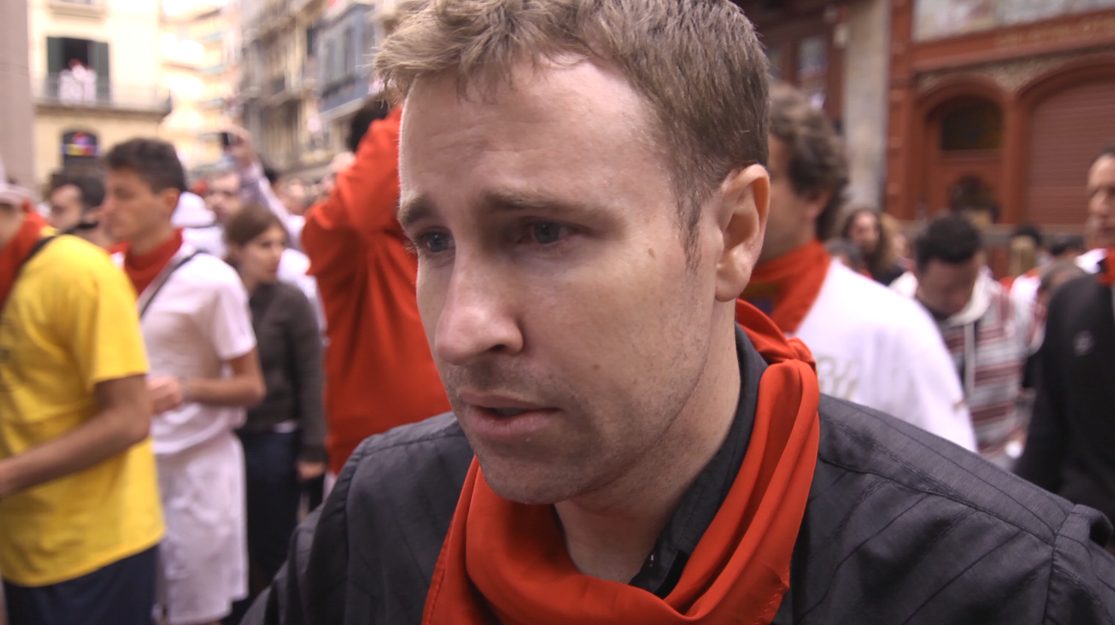
The edit took a long time. Brian Moghari had just finished college when it started, and drove out to Los Angeles. He cut the film in a shared studio the team called the Boxcar, on the top floor of a building on Traction Avenue in the Arts District, a single suite where a number of people ran their own businesses. The same building, the Binford Building, is the exterior of the apartment in the TV series New Girl, and Dennis remembers film crews outside shooting scenes for it at night.
“The edit was a constant back and forth between myself and Brian Moghari. He would build a scene, he’d send it, we’d talk about it in the context of the film, and then we’d move on. We jumped around a little bit, because we knew certain scenes would help drive other parts of the documentary, so it wasn’t a very linear process necessarily, but he did a phenomenal job.”
Dennis Clancey
Steve Cahill, the composer, also did sound design and scored parts of the film. The color was graded through Salt Digital, a Phoenix company. Dennis was in Los Angeles often during the edit, and describes it as a fun process.
When the cut was finished, Dennis made the DCP, the Digital Cinema Package that theaters project from, for the theatrical release, and started submitting the film to festivals.
Release
Chasing Red premiered in 2015 and won Best of the Fest, the top award at the LA Indie Film Festival. It played other festivals that year, including Newport Beach.
It then had a limited theatrical run in the United States, with screenings in Nashville, Washington DC, New York, Los Angeles, Phoenix and Chicago, plus a screening in Mexico City. The Chicago screening, on April 15, 2015, was covered by the Chicago Sun-Times. The film later went online through Vimeo and was then distributed by Magnolia Pictures; where it streams today is listed on What is Chasing Red?
Timeline
- July 2007: first interview filmed, with Ray Mouton, on July 6; Dennis runs for the first time that fiesta.
- 2008: research in Sevilla and at the Fuente Ymbro and Cebada Gago ranches; a cameraman films the full fiesta.
- 2009: Dennis returns to Pamplona to find the story.
- July 2011: Brandon Widener and two camera operators shoot the teaser; the name Chasing Red is in use.
- Before July 2012: Kickstarter campaign funds principal photography.
- July 7 to 14, 2012: the eight runs are filmed, with David Ubeda filmed at home in Hellín just before.
- 2013: drone establishing shots filmed.
- Edit: Brian Moghari cuts the film in the Arts District of Los Angeles.
- 2015: premiere, Best of the Fest at the LA Indie Film Festival, screenings in six US cities and Mexico City.
What the making of the Chasing Red documentary explains
Much of what is distinctive about Chasing Red comes from how it was made. It was planned by a director who had spent five years running and researching in Pamplona before the cameras rolled on the main shoot. A volunteer crew with many cameras on the route meant the film could follow four runners through eight runs without giving any of them a task. And the RED camera, the cable camera and a back-and-forth edit let individual runs be shown as they happened, slowed down where it counts.
What it is like to be on the street when the bulls pass is in What it’s really like to run with the bulls. Dennis still runs in Pamplona, and his runner page is on encierro.com.
Questions people ask
How long did it take to make Chasing Red?
About eight years, from the first interview in July 2007 to the premiere in 2015. The eight runs at its center were filmed in July 2012, after years of research and a teaser shot in 2011.
Who was on the crew of Chasing Red?
Brandon Widener led the production team and shot the 2011 teaser. Javier Armijo and Tristan Houghton were on camera in 2012, Houghton on the RED camera. Brian Moghari shot in 2012 and edited the film, Iker Zuasti, a co-producer, contributed footage from cameras along the route, and Steve Cahill composed the music.
How was Chasing Red funded?
Dennis Clancey paid for the research years himself. Principal photography was funded on Kickstarter, which raised $22,966 from 198 backers, and money for post-production came later through Indiegogo.
Were drones used in Chasing Red?
Yes. A drone was used in 2013, and several of its shots appear in the film as establishing shots. The runs themselves were filmed in 2012 from cameras on the ground, on balconies and on the cable camera above the route.
Where was Chasing Red edited?
In Los Angeles, in a shared studio on Traction Avenue in the Arts District, in the same building used as the exterior of the apartment in the TV series New Girl.
Sources
- Dennis Clancey, interview with Chasing Red, October 23, 2026.
- Travel Edits, “Chasing Red: One Man’s Obsession with the Running of the Bulls in Pamplona,” about 2013 (self-funding 2007 to 2011, 2011 concept trailer, Kickstarter total and backers, 19 camera types, LineCam, Tristan Houghton on the RED camera).
- Ray Mouton, Pamplona: Running the Bulls, Bars and Barrios in Fiesta de San Fermin, 2002.
- Wikipedia, “Jarred Land” (REDuser.net); Wikipedia, “Hellín.”
- I Am Not A Stalker, “The New Girl Apartment Building,” April 17, 2012 (837 Traction Avenue).
- Chicago Sun-Times, April 14, 2015 (Chicago screening).
- Arizona Foothills Magazine, March 31, 2015 (LA Indie Film Festival award, Phoenix screening).
- encierro.com, ranch histories of Fuente Ymbro and Cebada Gago.