
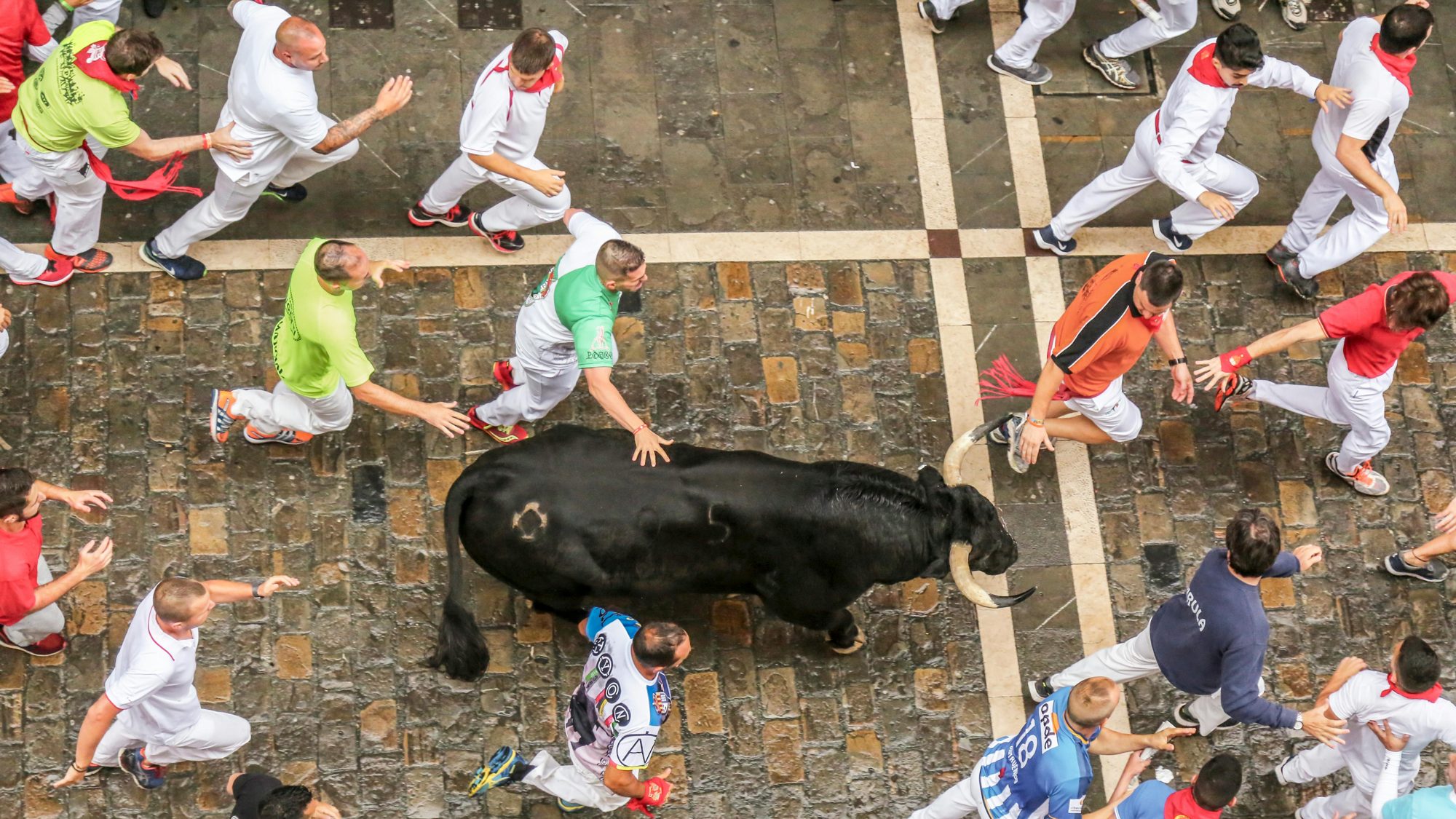
Filming the running of the bulls means capturing a few minutes of chaos, every morning for eight days, without ever standing in the way of the runners or the animals. Chasing Red did it in July 2012 from behind the barriers, with city press passes for every day of the fiesta, from balconies, from a cable camera strung over the route, and with footage shared by other productions. It also left one angle out on purpose: no camera was ever put on its runners.
This is how the filming was done, and the rules the production held to, explained by Dennis Clancey, who directed the film and ran in it. The crew, the cameras they brought and the RED camera operator who flew in from Australia are covered in Making Chasing Red. This page is about the street itself.
Key facts
- When: the eight runs of San Fermín, July 7 to 14, 2012.
- Permission: press accreditation from the city of Pamplona, with a position on the barrier for every day of the fiesta.
- Where the crew stood: between the two wooden barriers, alongside police, medics and photographers, never on the route itself.
- Cable camera: a LineCam Systems cable over the stretch from the top of the Cuesta de Santo Domingo into the town hall square, approved during the fiesta by Pamplona’s office of public security.
- Footage: from 19 different types of camera, as Dennis told Travel Edits in 2013.
- Not filmed: no camera on the film’s runners, no drone over the route, nothing on a bull.
Why filming the running of the bulls is so hard
The run covers about 850 to 875 meters of narrow streets, and a single runner’s moment with the bulls can last a few seconds. Nobody knows in advance exactly where a runner and the herd will meet. Chasing Red made that harder on itself by refusing to direct its four runners: they were never given tasks, and often did not know where the cameras were. What the film is about, and why it was built that way, is in What is Chasing Red?
The answer was to put as many cameras in as many places as the rules allowed, and to keep every one of them off the route.
The permission that matters: a place on the barrier
The main permission came from the Pamplona press office. Months before the fiesta, media can apply for accreditation, and one of the things it allows is filming from the vallado, the wooden barrier that lines the route. The city grants a section of the route and a specific day, based on a project’s history and the case it makes.
The system still works that way. Today the city takes applications from May 15 to June 15, issues encierro accreditation for a specific day, and has accredited media stand at the posts of the barrier in the sections set aside for them.
The production’s time and relationships in Pamplona, and a detailed proposal, got Chasing Red spots along the barrier for every day of the fiesta. For Dennis that was critical: he wanted several angles down at the level of the runners, which feel very different from anything filmed from a balcony. The production filmed from balconies too, but the shots at the runners’ eye level are the ones that make the film feel like the street.
Where the camera operators stood
Every ground-level operator stood on the far side of the barrier. Where the route has a double barrier, as it does all around the town hall square, there are two wooden fences with a gap between them. The only people allowed in that gap during the run are police, medics and a limited number of press. The film’s crew worked there as videographers with press passes. Encierro explains the double barrier and what the space between the fences is for.
That position kept the crew out of the runners’ way, and mostly out of reach of the bulls. Mostly.
“Because the cameramen are on the other side of the vallado, they’re protected in a way from the horns of the bull. But in some cases we had our cameramen, Tristan for example, and some of the other ones, who were very forward-leaning in terms of getting just the right shot. So in some cases they’re leaning over the barrier; they’re still potentially at some risk if a horn comes through the gaps in the barrier. For each cameraman, it was really up to them to assess their comfort level with their positioning along the vallado.”
Dennis Clancey
Tristan Houghton shot the runs on the RED camera. Whatever risk each operator accepted, none of them was ever on the route inside the barriers, and none of them impeded a runner.
Every angle: ground, walls, balconies and borrowed footage
The film’s own crew was small, so the production gathered footage wherever it could. That year Dennis also helped produce a segment for Xtreme Booking, a Hotels.com advertising series built around booking a room on the Hotels.com app in the middle of a stunt. Its first episode had a skydiver over Lake Tahoe. In the Pamplona episode, as Dennis describes it, the freestyle motocross rider Andy Bell, known from Nitro Circus, booked his room while running with the bulls.
Dennis advised that production on where to set its cameras. It had reserved balconies and a much bigger budget than Chasing Red, and its production company shared a lot of its footage with the film.
A second source was local. Iker Zuasti, a co-producer of the film based in Pamplona, had several cameras of his own along the run route, recording the runs, and gave the production that footage too.
Between those sources and its own crew, the production had far more cameras than it could have brought itself, and it went after every kind of angle: at ground level and even on the ground, low shots below walls, shots above walls, from the top of the barrier and from balconies. By the time the film was cut, it drew on footage from 19 different types of camera. How the edit turned all of it into one story is in Making Chasing Red.
The first cable camera over the town hall stretch
The hardest permission of all was for a camera that ran on a cable above the street. The production brought in LineCam Systems, a company that builds cable-suspended camera rigs, and flew two of its people to Pamplona.
A documentary crew putting a cable over the run route was unheard of at the time. Getting the license took months of coordination, sending documents and persistent follow-up. The approval did not come until the fiesta had started, at the office of Seguridad Ciudadana, Pamplona’s office of public security. The cable ran over the town hall section, from the top of Santo Domingo to the corner of the Plaza Consistorial. In an interview with Travel Edits in 2013, Dennis thanked the head of Pamplona public safety for allowing the production to use the LineCam system. By his account it was the first cable ever approved over that stretch.
Cable cameras are now part of how the run is shown on television. RTVE, the Spanish public broadcaster, which televises the runs, first used a cable camera over Calle Estafeta in 2014, and added one over the Santo Domingo stretch and another from the Museo de Navarra into the town hall square in 2018. Dennis believes the broadcaster took the idea from seeing it done in 2012.
Those cameras now do something for runners as well. Because the camera tracks over the lead animal as it moves down the cable, runners can time their run by where it is.
How first-time runners use the cable camera to know the bulls are close is in What it’s really like to run with the bulls.
One drone shot, and none over the route
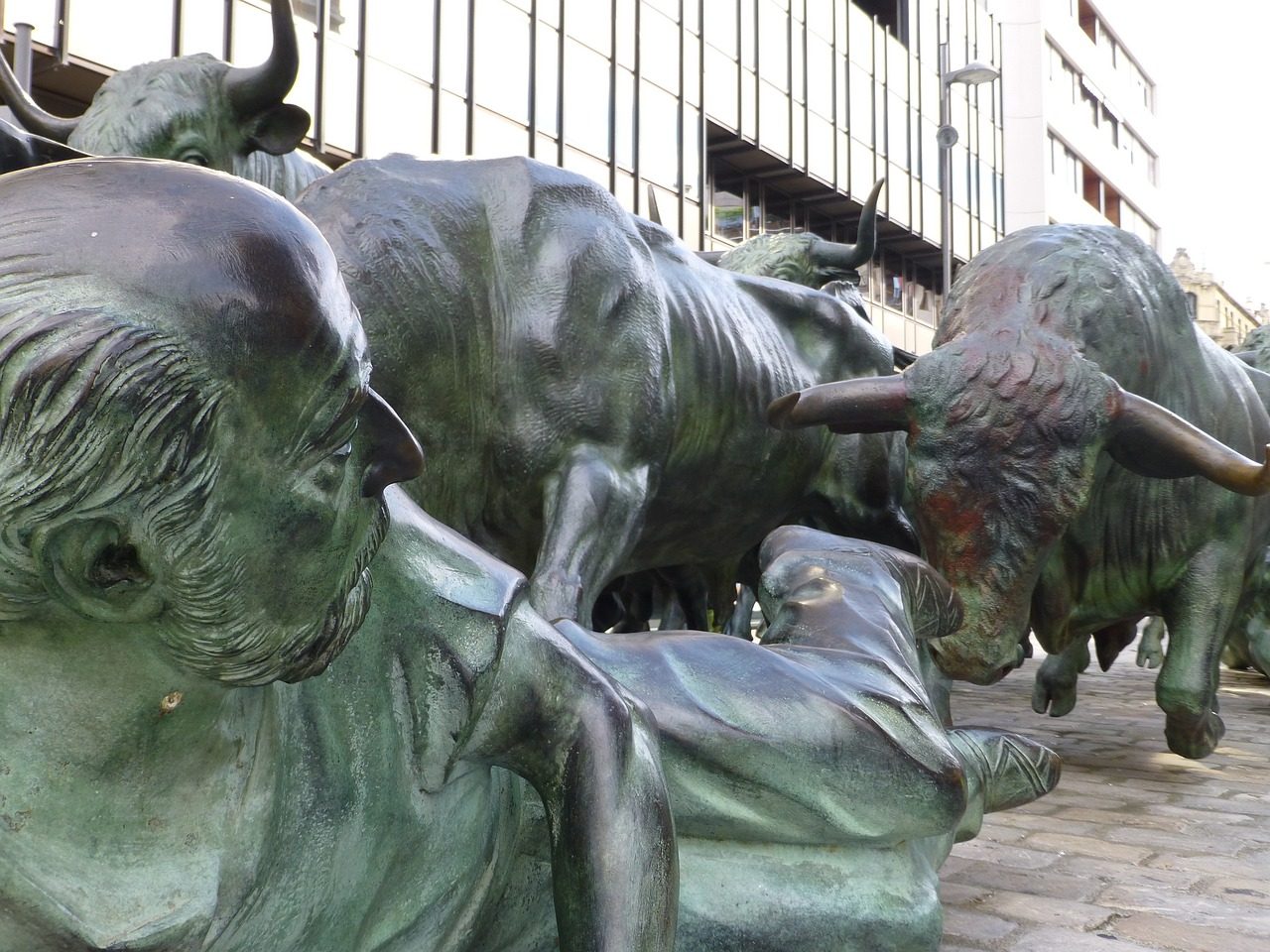
There is one drone shot of the run in Chasing Red, and it was not taken over the street.
“You’re not allowed to put a drone physically over the run route. You just can’t do it. It puts people at risk. It puts the bulls at risk, flying over something, and running the bulls is such an orchestrated event. A bull hit by a drone that’s falling out of the sky could be very dangerous.”
Dennis Clancey
The production never flew a drone over the route. The shot in the film was taken from a distance, from across the river, by an individual who provided it. It fills in an angle; it does not hover over anyone.
People have also asked Dennis about putting a camera on a bull. It was never considered, and never requested from the city, which would not grant it. It would be seen as disrespectful to the bulls.
The angle the film left out: cameras on its runners
The obvious shot for a film about runners is the runner’s own view, a camera strapped to a head or a chest. Chasing Red does not have it.
“The one angle we don’t have in Chasing Red, that we held off of, is actually having a camera on the runners that we had. We wanted to respect the tradition, and it’s against the rules of the run to record one’s own run. We wanted to be true to the tradition. By violating that one thing, I felt that we would be showing ourselves to not be credible, because those that are immersed in the tradition would never consider recording their own run.”
Dennis Clancey
The rule is written down. Pamplona’s encierro ordinance prohibits using any device that records image or sound, mobile phones included, on the route or in the reserved barrier areas without authorization, and the city treats it as a serious offense with fines from 601 to 6,000 euros. In 2026 the municipal police confiscated 54 pairs of recording glasses on the route during the fiesta. The rules runners must follow are listed in What it’s really like to run with the bulls.
There was a personal reason as well. Dennis, David Ubeda and Bill Hillmann all had reputations in the town, and none of them would ever consider recording a run.
Never ask a runner to do what you wouldn’t do
Dennis ran in the film himself, and part of the reason was a principle.
“Part of putting myself in the documentary is, I believe that you should never ask someone to do something you wouldn’t do yourself.”
Dennis Clancey
The runners ran as they normally would. Bill Hillmann and David Ubeda ran in their usual sections, Josiah Lloyd, running for the first time, ran where Dennis had coached him to, and Dennis ran in his own area. David and Bill were never told where the cameras were. The crew relied on how consistently each runner returned to the same stretch every morning, and positioned themselves around it.
The cameras still had an effect. Runners are naturally somewhat competitive, Dennis says, and with cameras on them they felt a pull to run a certain way.
“Even though the run is not a competition, we want to at least demonstrate the right behavior, particularly with all the cameras; you want to make sure you’re properly modeling the tradition.”
Dennis Clancey
Was anyone hurt during the shoot?
No one was seriously hurt. But nobody came through the eight runs untouched, and the film does not pretend otherwise.
“I got tripped by another runner on one of the runs, and I had a knee contusion, and it made my later runs challenging, but I was able to overcome it.”
Dennis Clancey
Dennis went under the herd at one point, which is when he hurt his knee, and limped for the rest of the fiesta. Josiah Lloyd skinned his knee. Bill Hillmann fell a couple of times. David Ubeda fell during the shoot when other runners went down in front of him, and he ended up under the herd. Every one of them was able to keep running. The film also covers an injury David suffered in an earlier year, when he went under the herd, as described by his family.
The lesson Dennis draws from those falls is one every runner should know.
“If the bulls are right behind you and you go down, the rule is that you protect your head and you stay down so that the bulls can leap over you. If you try to get back up as they’re coming through, then you can be an obstacle to them, and they’ll need to clear that obstacle, potentially with their horn. That’s when it gets really dangerous.”
Dennis Clancey
None of this is encouragement to run. The run is dangerous, people are badly hurt in it, and some have died. Chasing Red opens on a runner’s death for exactly that reason, as told in How the Chasing Red story evolved. Encierro has a full guide on what to do if you fall.
What filming the run this way gave the film
The rules shaped the film as much as the cameras did. Staying behind the barrier forced the crew into many positions instead of one perfect one. The cable camera gave the town hall stretch a view that, by Dennis’s account, no one had captured before. Refusing to mount cameras on the runners kept the film credible with the people who run every year, and leaving the runners free to run as they always do meant what is on screen is what actually happened.
The production did all of it on a small budget, with flights for the camera crew and the LineCam team taking most of the money; that story is in Paying for an independent documentary. The places the film was shot are mapped in Where we filmed Chasing Red, and the other films made about the run are in Running of the bulls documentaries. Dennis’s runner page is on encierro.com.
Questions people ask
Do you need permission to film the running of the bulls in Pamplona?
Yes, to film from the route or the barriers. The city of Pamplona accredits media for the encierro, for a specific day, and accredited crews stand at the barrier posts in sections set aside for them. Recording on the route without authorization is prohibited.
Can runners film themselves with a phone or a head camera?
No. Pamplona’s encierro ordinance bans any device that records image or sound, phones included, on the route without authorization, with fines from 601 to 6,000 euros. Chasing Red never put a camera on its runners for that reason, and out of respect for the tradition.
What is the cable camera over the running of the bulls?
A camera that travels on a cable above the street, following the lead animal. Chasing Red got approval for one over the town hall stretch in 2012. RTVE has used cable cameras in its broadcasts since 2014, and runners now use them to tell where the herd is.
Were drones used to film the running of the bulls in Chasing Red?
Not over the route, which is not allowed. The film has one drone shot of the run, taken from a distance across the river by an individual who provided it to the film.
Where do camera crews stand during the running of the bulls?
Behind the barrier. Chasing Red’s ground-level operators worked in the gap of the double barrier, a space shared only with police, medics and a limited number of press, and others filmed from balconies above the street. None of the crew stood on the route itself.
Sources
- Dennis Clancey, interview with Chasing Red, October 23, 2026.
- Travel Edits, “Chasing Red: One Man’s Obsession with the Running of the Bulls in Pamplona,” about 2013 (19 camera types; LineCam use allowed by the head of Pamplona public safety).
- New Atlas, “LineCam suspended camera system,” April 2, 2013 (LineCam Systems).
- Ad Ruby, “Hotels.com: Xtreme Booking,” September 16, 2011 (the series and its Lake Tahoe skydive episode).
- Wikipedia, “Andy Bell (freestyle motocross rider)” (Nitro Circus).
- Ayuntamiento de Pamplona, “Acreditaciones San Fermín 2026” (press accreditation process).
- Ayuntamiento de Pamplona, July 11, 2026, on recording devices seized on the route, citing Article 11 of the Ordenanza del Encierro.
- Panorama Audiovisual, July 4, 2014, and July 5, 2018 (RTVE’s cable cameras over the encierro).
- encierro.com, “Barreras: the barriers of the encierro” and “What to do if you fall in the running of the bulls.”