
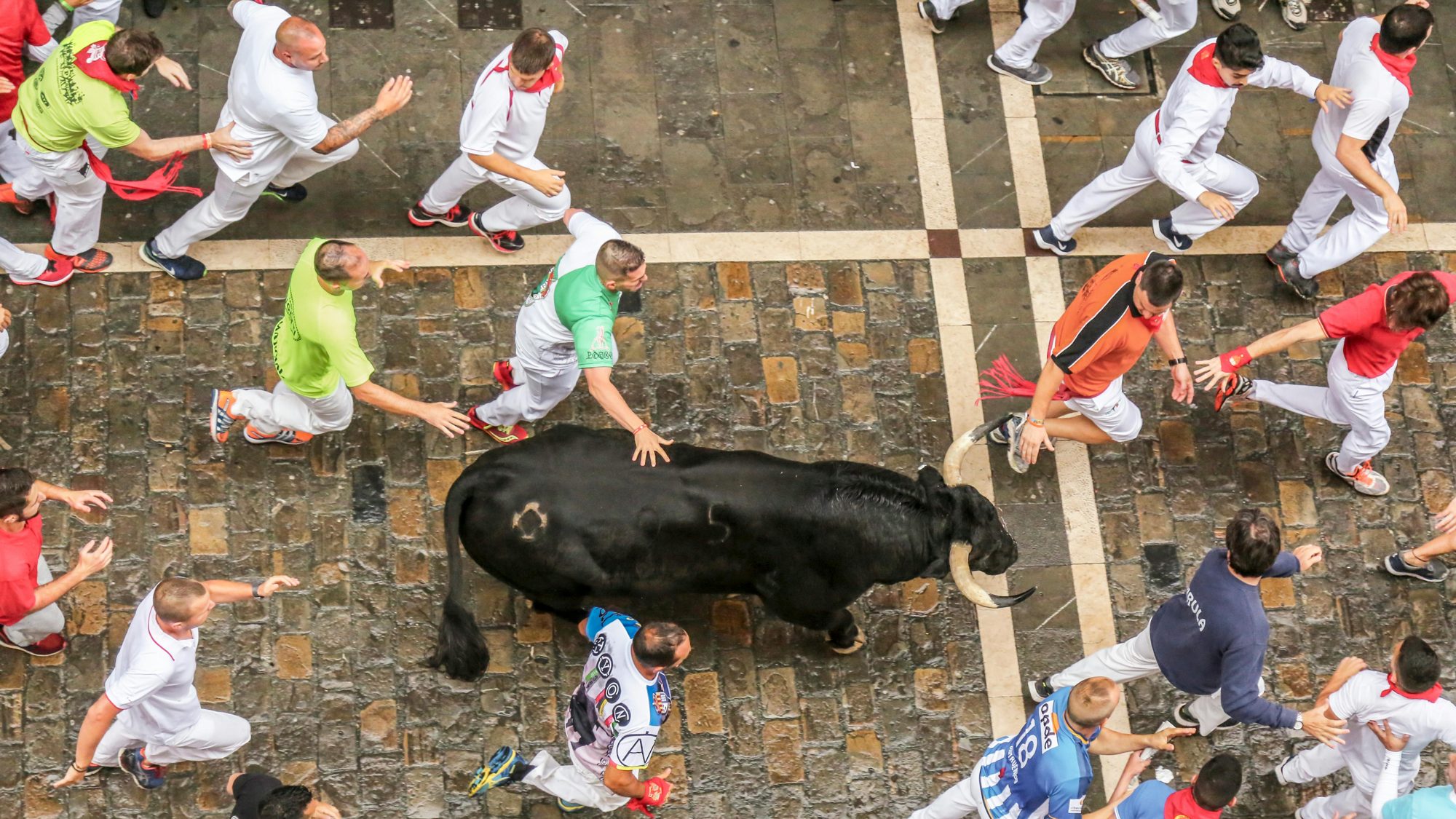
Running with the bulls in Pamplona is over fast and starts long before 8 o’clock. For a first-timer it is a night of little sleep, an hour of waiting on the street, a few seconds of running alongside animals moving faster than any person, and then a rush of relief or elation.
This is what that morning is actually like, explained by Dennis Clancey, who has run in Pamplona since 2007 and directed the documentary Chasing Red. It is not encouragement to run. Whether to run is a personal decision, and it is a dangerous one.
Key facts
- When: every morning of San Fermín, July 7 to 14, at 8 a.m.
- Who may run: adults 18 and over. No one may enter the route after 7:15.
- The herd: six bulls and six steers, followed by a second group of steers that sweeps the street behind them.
- How fast: the herd averages roughly 24 km/h (15 mph) over the whole route, with faster bursts.
- How long: from release to corral, as little as about two minutes. A single runner’s run is often 40 meters or less.
- The route: between about 850 and 875 meters, depending on who measured it (the measured answer).
The night before
First-time runners often barely sleep. Some never go to bed, and the hope is that they weren’t out partying all night.
“It’s common to be quite nervous, common to be questioning your decision making. There are so many unknowns when you run for the first time. You’re asking yourself a lot of questions, so it’s easy for your mind to race and for you to get very little sleep the night before.”
Dennis Clancey, director of Chasing Red
What helps is simple: be sober, and lie down for at least a while, so you aren’t exhausted when it counts.
Getting on the route
Adrenaline builds as 8 o’clock approaches. Be on the route by 7. That leaves time to find your spot if you get turned around, and nothing to worry about if the line moves early. By the city’s rules, no one may enter after 7:15, and police can close access sooner.
Until shortly before the run, runners wait in two places: the Town Hall square and the Cuesta de Santo Domingo, the slope where the run begins. Around 7:45 the police let runners move up to any part of the route they want.
Walk the route the day before, and come up with a plan for where you will run. Learning from runners who do it every year helps, which is what Encierro’s tours are for.
The last minutes before 8
Once everyone spreads out, walk the stretch you intend to run and go through it in your head one more time. Use the space to stretch and jog a little. It can otherwise be a lot of standing in the hour before the bulls approach, so keep moving.
Before the run, runners also sing to San Fermín, the patron of the festival, asking for his protection. More on that, and on what the encierro means to runners, is in The encierro: what the running of the bulls really is.
The first rocket: don’t run yet
At 8 o’clock a rocket, a cohete, signals that the bulls have been released. Many people take off running at that sound.
“A hundred percent of those people that take off running at the sound of the first cohete are first-time runners who are uneducated about the run. You really want to wait.”
Dennis Clancey
There are two reasons. In some parts of the route it can take the bulls two minutes to reach you, so running early burns energy you will need later. And it puts you in a crowd of people who don’t know what’s happening, picking up the wrong cues from the wrong people.
The goal is to let the bulls come to you, and to get up to speed just before they reach your position, so you are at your fastest as they pass.
Four rockets
The city’s rules set four rockets: the first just before the gate of the corral in Santo Domingo opens, the second when the last bull has left the corral, the third when all the bulls have reached the end of the route, and the fourth when the last one is in the corrals there. Away from Santo Domingo, runners listen for the second. The third and fourth often go unnoticed, because by then the bulls have already passed or are passing.
How to know the bulls are close
First-timers are best off in sections of the route with a cable camera: a camera that runs on a cable above the street and tracks the lead animal. Where it moves, the herd is. Those sections are the end of Santo Domingo, the Town Hall square and Calle Estafeta.
When the bulls reach you
Be moving. The most exposed people on the route are the ones standing still along the sides.
“If a bull does charge up alongside the run route, along the barrier, along the wall, if you don’t have any momentum, it’s very hard to get out of the way, because the bulls are moving incredibly fast. It puts you more at the mercy of the bull.”
Dennis Clancey
The danger along the walls is not the walls themselves. It is being stuck among people who aren’t moving. But the center of the street, the first time you run, is where people sprint to get in front of the bulls. A first-timer isn’t trying to run in front of the bulls. You want to be running down the street alongside them as they overtake you.
A well-timed first run might be a 40-meter dash. It might be 10 feet, or 100 meters.
The barriers are not an escape hatch
The route is lined with a double wooden barrier, and the space between the two fences is a refuge. But when the bulls are close, the police will not let you climb into it. Someone stopping to throw a leg through the slats becomes an instant obstacle for everyone running behind them. The gap is a way off the route before the bulls are released, or later if a bull has been separated from the herd and you need to get to safety. Encierro explains the barrier system in detail.
If you fall
When the bulls are near, or the people around you are at a full sprint, stay down and protect your head. A bull can jump over something lying on the ground in front of it, because it has too much momentum to stop or go around anything directly in its path. A runner who is down gives the bulls something they can jump over.
“If you attempt to get up as they are coming through your position, you won’t have any momentum yet, so you’ll be a stationary object that they now cannot jump over because you’re standing upright, and they have to lower their head and clear their way. That’s when something ugly happens.”
Dennis Clancey
If you fall well before the bulls are close, with the street open and nobody sprinting, getting up can be fine. That is why timing matters: if you only start running when you know the bulls are approaching, you’ll know to stay down if you fall at that moment. Encierro has a full guide on what to do if you fall.
After the bulls pass
Stop. Running after the bulls is against the rules of the run, and any respectable runner stops once they pass. The street clears quickly. When you stop and look around, the people still near you are established runners, or at least people who understand the tradition.
About 45 seconds after the herd, a second group of steers comes through. They are not usually going after anyone. Give them plenty of space.
Then find a spot to step off the route, putting a leg through a barrier, or meet your friends and family on the street itself. Your run isn’t over until you are off the route. Don’t wait for a rocket. A clear sign the run is over is the carpenters starting to take down the barriers, as they do on Calle Mercaderes as soon as it ends.
How it feels afterward
There is no single feeling after a first run, and Dennis has talked with thousands of runners about theirs.
“Some people are relieved that it’s over. Some people are frustrated they didn’t get a better run. But most people are at least elated, and want to talk through their run with someone, share the details of their run with another person.”
Dennis Clancey
What to wear and how to prepare
- White, with a red pañuelo. The neckerchief is traditional, and it must be tied in a slip knot. A fixed knot can catch on a horn, and runners have been picked up by their own pañuelo or sash.
- Skip the sash. Tied the usual way, it often comes loose, ends up on the ground, trips other runners and litters the route.
- Shoes you feel agile in. Running shoes or sneakers. The city bans footwear that impedes running, such as sandals, flip-flops and heels.
- Carry nothing. Bags, bottles, cameras and phones are banned on the route, and so is recording.
- Training. Sprints from about 50 to 400 meters. Most runs are under 100 meters, but the longer distance helps if a bull is loose and you have to run farther to get away from it.
Encierro’s uniform guide covers the clothing in more detail.
The rules runners must follow
The city of Pamplona publishes the rules every year. Among them: no runners under 18; no one on the route drunk, on drugs or otherwise unfit; no bags, bottles, cameras or phones; no running toward or behind the bulls; no touching them or drawing their attention; no stopping at barriers or in doorways in a way that blocks other runners; and no waiting in corners or doorways before the release. Anyone breaking them is removed by the police.
Seeing it before you run it
Chasing Red follows four runners through the eight runs of San Fermín 2012, filmed from cameras placed along the route. What is Chasing Red? tells the story of the film, and the other films about the run are in Running of the bulls documentaries.
Questions people ask
What time should you be on the route to run with the bulls?
By 7 a.m. No one may enter after 7:15, and runners wait at the Town Hall square or on the Cuesta de Santo Domingo until the police let them move along the route, around 7:45.
Should you start running when the rocket goes off?
No. The first rocket only means the bulls have been released. Wait until they are close, and get up to speed just before they reach you.
How far does a first-time runner actually run?
Usually a short distance. A well-timed first run might be about 40 meters, sometimes much less.
What should you do if you fall during the running of the bulls?
If the bulls are close or the runners around you are sprinting, stay down and protect your head. Getting up as they arrive makes you an obstacle they can’t jump over.
How long is the route?
Between about 850 and 875 meters, depending on the source. The city gives 848.6 meters; a 2022 wheel measurement found about 875.
Can you jump into the barriers to escape the bulls?
Not when the bulls are close. Police won’t let runners through then, because it blocks the people behind. The space between the fences is a way off the route before the release, or later if a bull is separated from the herd.
Sources
- Dennis Clancey, interview with Chasing Red, October 22, 2026.
- Ayuntamiento de Pamplona, Bando de San Fermín 2026, section 5 (start time, rockets, entry cutoff, prohibitions).
- Ayuntamiento de Pamplona, “The Bull Run” (herd composition and average speed), as cited by Wikipedia, “Running of the bulls.”
- encierro.com, “How Long Is the Running of the Bulls? The Measured Answer” (route length).