
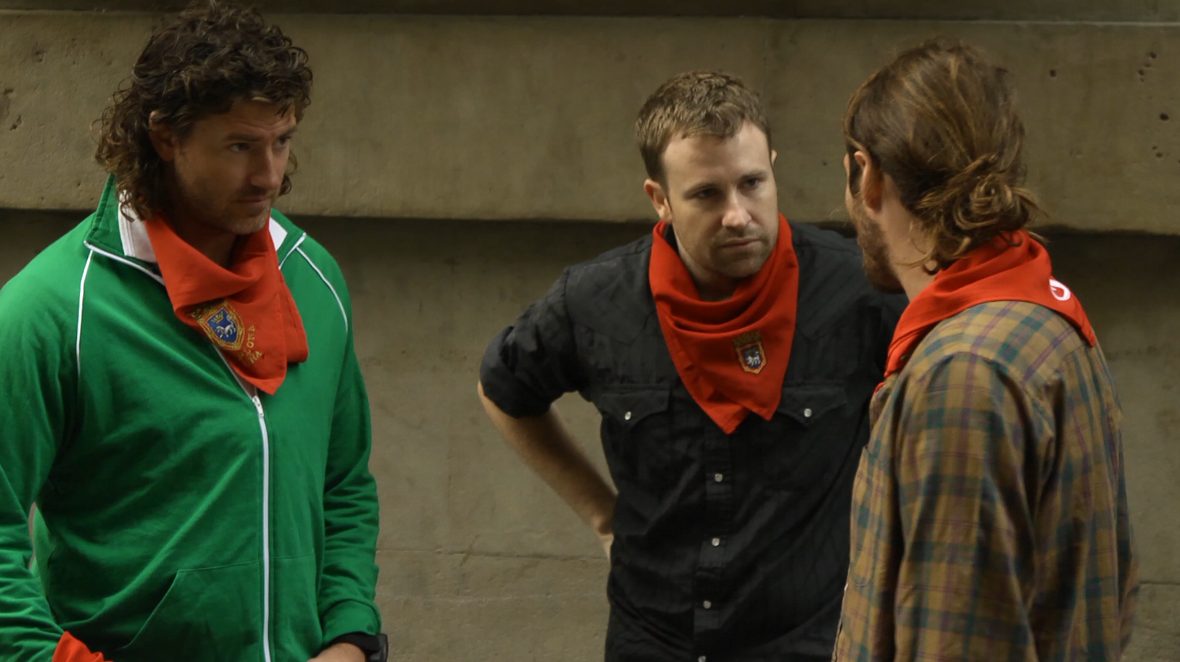
The Festival of San Fermín in Pamplona runs for nine days, from noon on July 6 to midnight on July 14. The running of the bulls, at 8 o’clock each morning from July 7, takes a few minutes of each day. The rest is the fiesta: processions, music in every street, peñas, meals that last for hours, and a city of people dressed in white and red.
This is the fiesta beyond the run, as Dennis Clancey, director of Chasing Red, has lived it since 2007.
Key facts
- Dates: July 6 to 14 every year.
- Opening: the Chupinazo, a rocket fired at noon on July 6 from the balcony of the town hall.
- The runs: every morning from July 7 to 14 at 8 o’clock.
- The procession: July 7, the feast of San Fermín, Pamplona’s patron saint.
- Closing: Pobre de Mí, at midnight on July 14 in front of the town hall.
- The dress: white with a red pañuelo, the neckerchief.
San Fermín, the saint and the fiesta
San Fermín is the patron saint of the festival, and he is present in every part of it, from the song runners sing to him before the encierro to the procession on his feast day.
“Whether or not you believe in him, San Fermín embodies the spirit of the fiesta.”
Dennis Clancey, director of Chasing Red
The unwritten rules of the fiesta
A fiesta needs few rules, and some of the most important ones are not written anywhere.
No fighting. Being involved in violence during the fiesta is considered very poor form: disrespectful to the tradition, disruptive to the people around you, and unsettling to San Fermín himself. As much as people drink across the nine days, fights are uncommon, which makes the fiesta more family friendly than an event with the same amount of drinking would be in the United States.
Don’t mess with someone else’s fiesta. Nine days of fiesta fill the city with people celebrating in very different ways.
“If no one’s messing with your fiesta, don’t go messing with theirs. Everyone has a different fiesta and should be left to enjoy it, so long as they’re not messing with someone else’s.”
Dennis Clancey
Everyone is equal. When Dennis first went to Pamplona, there was a hierarchy among some groups of foreign visitors, not among the locals: people who had been coming longer acted as gatekeepers to the fiesta, and newcomers had to earn their way in. He rejects that. It doesn’t matter how good a runner you are, or whether you run at all. People are judged by who they are. And if you have been coming longer than someone else, it is not for them to try to get into your fiesta. It is for you, if you are so inclined, to welcome them into yours.
That idea shaped Chasing Red. Dennis looked for runners who were independent figures at the fiesta and who embodied its spirit. The idea of the fiesta is that everyone is equal.
The white and red
There is a story often told about the white and red: that it is the one time of year all the classes of society sit at the same table. It is probably more story than history. The all-white outfit with red accents is relatively modern. One account credits a peña founded in 1931, La Veleta, whose mostly working-class members chose inexpensive white clothes with red details, and says the look became the standard for everyone from around the 1960s. Part of the point was to keep the fiesta from turning into a carnival of costumes.
The Chupinazo: noon on July 6
The fiesta opens at noon on July 6 with the Chupinazo, a rocket fired from the balcony of the town hall over a square packed with people in white, their red pañuelos still in their hands or pockets until the rocket goes up.
Dennis has watched it from a balcony above the Plaza Consistorial, the square in front of the town hall, and for many years from the ground right in front of the town hall’s facade, drenched in sangria. Years ago it was more dangerous down there. There was no ban on glass in the square, so bottles of sangria rolled underfoot and champagne bottles broke on the stones. Today the city bans glass bottles and glasses in the Plaza Consistorial and the Plaza del Castillo.
Shoes are another hazard. The crowd is so tight that one step on your heel can take your shoe, which is why, right after the Chupinazo, people can be seen searching for their other shoe. Many give up and take whatever shoe they can find when the square clears. Tie your laces tight.
Now Dennis usually spends the Chupinazo working as a waiter at the clubhouse of his peña, La Única. Every member works one shift during the fiesta, and he takes his as early as possible, before the runs start, so that the eight mornings of the encierro are free for the run route and for the first-time runners he instructs. It is also a chance to practice a little Basque.
La Única is considered the oldest peña in Pamplona, with records going back to 1913. The peñas, the social clubs of the fiesta, carry much of its music and life through the streets.
The procession on July 7
July 7 is the feast of San Fermín, and his statue is carried through the old town in procession. Dennis attended it in his first years at the fiesta, and the Chasing Red crew filmed it as part of the research for the film.
One of the best things a first-timer can do at San Fermín is to find a procession and follow it, whether it’s the statue of San Fermín on the 7th or a roving band at any hour of the fiesta.
Pobre de Mí: midnight on July 14
The fiesta ends at midnight on July 14 with Pobre de Mí, “poor me,” sung in front of the town hall as the nine days come to a close. Dennis’s first was in 2007. In 2021, when the festival was officially cancelled because of the pandemic, he was in Pamplona for the unofficial gathering, watching from a hotel room overlooking the town hall square.
The last run is at 8 o’clock that morning, and some years he leaves town before Pobre de Mí. One way he likes to end the fiesta is to take the bus to Saint-Jean-Pied-de-Port, in France, and walk the Camino de Santiago back over the Pyrenees to Pamplona, a way of getting back into nature after nine days in the streets.
The night of the drums
Some of the best of San Fermín is on no official schedule. One night of the fiesta, everyone with a drum gathers around midnight and drums to a single beat, winding through the old town. It is known as the Struendo, an informal tradition that in recent years has been held on the night of July 12. Dennis finds it lovely simply to follow the drummers and dance to the beat.
“One of the most important things to do at some point of fiesta is just to get lost in it, to see where it takes you.”
Dennis Clancey
Beyond the old town
It is easy to spend the whole fiesta in the Casco Viejo, the old town. Just outside it are parks where families gather, with food stalls and more. To the north, in the Parque del Runa, there is a fairground, if you enjoy a carnival atmosphere.
Eat well, and drink like a local
A bocadillo, a sandwich eaten in the street, is part of the fiesta. But take time for real meals too: a chuleta, the Navarran steak, with a good Rioja, and the cooking of Navarra in Pamplona’s restaurants, including the Michelin-starred Rodero and Kabo.
“The best fiesta balance is the finest and the most basic that Pamplona has. Drinking a nice bottle of Rioja, and then the next day having a bottle of cheap sangria.”
Dennis Clancey
If you aren’t drinking a caña, a small beer, or wine, skip the sangria at the bar and order a tinto de verano, red wine with lemon soda, the more local choice. A vermouth or a sidra, cider, are good options too.
The run, and the film
Every morning of the fiesta at 8 o’clock, the bulls run. What the encierro is, and what it is like to run it, are in The encierro: what the running of the bulls really is and What it’s really like to run with the bulls. Chasing Red was filmed during the 2012 fiesta; its story is in What is Chasing Red? For dates and the daily program, Encierro keeps a San Fermín guide.
Questions people ask
When is the San Fermín fiesta?
Every year from July 6 to July 14 in Pamplona, Spain. It opens with the Chupinazo at noon on July 6 and closes with Pobre de Mí at midnight on July 14.
What is the Chupinazo?
The rocket fired from the balcony of Pamplona’s town hall at noon on July 6 that opens the Festival of San Fermín.
What is Pobre de Mí?
The closing of the fiesta at midnight on July 14, when people gather in front of the town hall to sing “Pobre de mí,” “poor me,” as San Fermín ends.
Why does everyone wear white and red at San Fermín?
The white and red has become the dress of the whole city during the fiesta. The all-white outfit is relatively modern, becoming standard around the 1960s; a common story says it puts everyone on equal footing.
What else is there to do at San Fermín besides the running of the bulls?
Follow a procession or a roving band, find the night of the drums, eat a long meal, visit the parks and the fairground outside the old town, and let the fiesta take you where it goes.
Sources
- Dennis Clancey, interview with Chasing Red, October 22, 2026.
- Ayuntamiento de Pamplona, Bando de San Fermín 2026 (dates, glass ban in the Plaza Consistorial and Plaza del Castillo).
- sanfermin.com, “The Sanfermin peñas” (La Única, earliest records 1913).
- sanfermines.net, “The origin of the San Fermín attire” (La Veleta, 1931; standard from about the 1960s).
- Onda Vasca, on the Struendo (night of July 12).
- Onda Vasca, on the fairground in the Parque del Runa.
- Michelin Guide, Rodero and Kabo, Pamplona.