
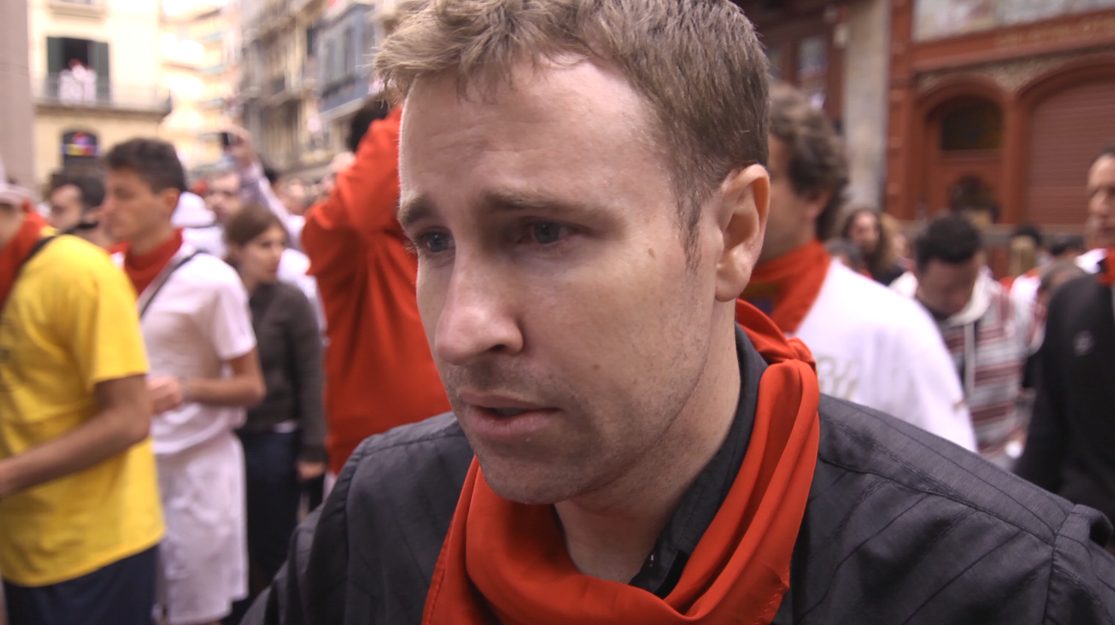
The story of Chasing Red changed more than once between 2007 and the final cut. It began as The Pamplona Project, a working title for a film with no story yet. It became a character-driven documentary about four runners whose lives cross during the eight runs of San Fermín 2012, opening on a runner’s death and ending at the Portal Nuevo, one of the old gates of Pamplona.
This is the record of how the story of Chasing Red evolved: the choices behind it, told by Dennis Clancey, who directed the film and ran in it. How the film was physically made, the crew, the cameras and the money, is in Making Chasing Red. What the film is, and who is in it, is in What is Chasing Red?
Key facts
- Working title: The Pamplona Project, used for years before the title Chasing Red existed.
- Idea to final story: the idea dates to 2007; the character-driven structure came together in late 2011 and 2012.
- The spine: the eight runs of the 2012 Festival of San Fermín, kept in the order they happened.
- The runners: Dennis Clancey, Bill Hillmann, David Ubeda and first-time runner Josiah Lloyd.
- The opening: a runner’s death, so the film could not be read as glorifying the run.
- The ending: planned for Bill Hillmann in Cuéllar; the film ends instead with the meaning of the title and a walk through the Portal Nuevo.
2007: a subject without a story
When Dennis Clancey first went to Pamplona in 2007, he had a subject and a camera, and not much else.
“2007, I had no real concept of what it would be. I had an initial desire to start filming the traveling that I had been doing, and the running of the bulls seemed like the first great subject matter that I could focus on and build a story around.”
Dennis Clancey, director of Chasing Red
The project had a name that said as much. “For many years, it was just called the Pamplona Project,” he says. How the title Chasing Red came later, and what it means, is in What does “chasing red” mean?
Learning what a documentary story is
Dennis had no training as a filmmaker. “I didn’t have a background in documentary filmmaking at all, and my understanding of story in documentaries was quite basic,” he says. “I committed over those years to study different documentaries, find ones that I liked, and watch pretty much all the classic ones.”
He named four as early influences:
- Salesman (1969), by Albert and David Maysles with Charlotte Zwerin, which follows door-to-door Bible salesmen.
- The Thin Blue Line (1988), by Errol Morris, about the conviction of Randall Dale Adams for the killing of a Dallas police officer.
- Dear Zachary: A Letter to a Son About His Father (2008), by Kurt Kuenne.
- Koyaanisqatsi (1982), by Godfrey Reggio, a film with no narration or dialogue at all.
Another documentary he admired was Enron: The Smartest Guys in the Room (2005), directed by Alex Gibney and released by Magnolia Pictures. Years later Magnolia Pictures took an interest in Chasing Red and became its distributor, which Dennis says he was really excited about.
A film made two weeks a year
The project was never a full-time job, and that shaped the story as much as any film did.
“When I started Chasing Red, I was in the Army; when I finished it, I was working for Amazon.com. So I always had something else for the majority of the year, and then I’d pack much of my work into those two weeks or so that I was in Spain each summer. That elongated the process a little bit, but it also gave me time to really get into the culture of Fiesta, become part of it, versus being a spectator who would learn about Fiesta through others.”
Dennis Clancey
2009: putting the camera down
By 2009, two years in, Dennis had spent the research years watching films and reading. The plan for that fiesta was “to just enjoy Fiesta a bit, not think about the making of a documentary, but experience Fiesta in a way that would allow me to connect and find my story.”
That meant becoming a runner first. “2009 was an opportunity for me to enjoy the run, to develop myself as a runner,” he says. He was improving with each run, in the length and speed of his runs and in the quick decision making that takes time to develop in a serious runner.
“I also got to do the simple things that you don’t do when you’re running around with a camera: walk, meander through the old city, and when you intersect with a roving band, just following it and dancing with it and seeing where it’ll take you. That’s one of the great things about Fiesta and the Casco Viejo, the old city: the ability to get lost in it, by where the alegría of Fiesta takes you.”
Dennis Clancey
That time inside the fiesta showed him what was missing from the films already made about it. “What I found was that documentaries that had been done on Pamplona were typically by outsiders attempting to find out about it through people who were on the inside.” Chasing Red would be made from the inside. The other films about the run, and how they compare, are in Running of the bulls documentaries.
Why Chasing Red follows intertwined runners
The structure of the film arrived late. “The broad brushstrokes of a character-driven documentary didn’t come together until late 2011, 2012, as we were planning the principal production,” Dennis says.
In 2011 Brandon Widener and two other camera operators shot a teaser in Pamplona. Its runners were college friends of Dennis’s, and none of them appear in the finished film. In conversations with Widener afterward, the two talked about the project in terms of character-driven and event-driven stories, and Dennis decided the film would follow several runners whose lives intertwine during one fiesta. The event became the eight runs of San Fermín 2012, the spine of the film. That production story is told in full in Making Chasing Red.
Even then, the plan was only a plan. “There were also small things that changed in the process of filming those days, because you don’t know what’s going to happen on the run route every morning.”
How the runners were chosen
Each of the four runners was chosen for a reason the story needed, not for a biography.
The director in his own film
“I knew, given my time in Pamplona and my passion for instructing other runners, that I wanted to be in the documentary myself. That was somewhat practical, putting myself in it. I knew that I could demand of myself to do things during that fiesta; I could rely on myself to do certain things on the run route if I needed something to carry the story a bit further.”
Dennis Clancey
It also solved problems later in the process. “I also knew I’d be able to rely on myself whenever additional interviews needed to be done. I could help craft the narration, and it made more sense if I was actually in the film versus trying to narrate as an outside director.”
A first-time runner
The film needed someone new to the run, and Dennis teaching him. “I knew we wanted to capture me coaching a first-time runner,” he says. That runner was Josiah Lloyd.
An independent runner
Bill Hillmann, from Chicago, first ran in Pamplona in 2005. By Dennis’s account he missed a number of years and came back around 2009, when Dennis was also becoming a runner. Bill was getting strong runs and making a name for himself. What drew Dennis was his independence. “He charted his own path at Fiesta; he was his own person,” Dennis says. “Our trajectories as runners paralleled each other.”
A Spanish runner
The fourth place in the story was for a Spaniard who had grown up in the culture of running with bulls and had been doing it since he was a kid. That was David Ubeda.
Dennis knew David’s runs before he knew his name, from the photos posted outside Foto Auma, a photo shop in Pamplona. “He wore this cap and a black shirt, just like I wore a black shirt, though we were in different sections of the run route. I came to admire his runs.” A late conversation with a friend of David’s revealed that he lived in Arizona. David, a solar engineer from Castilla-La Mancha, was living in Tucson; Dennis was in Phoenix, working for Amazon.com. David drove up from Tucson for lunch, the two became good friends in the year before filming, and David became the film’s Spanish runner.
Why the film opens on a runner’s death
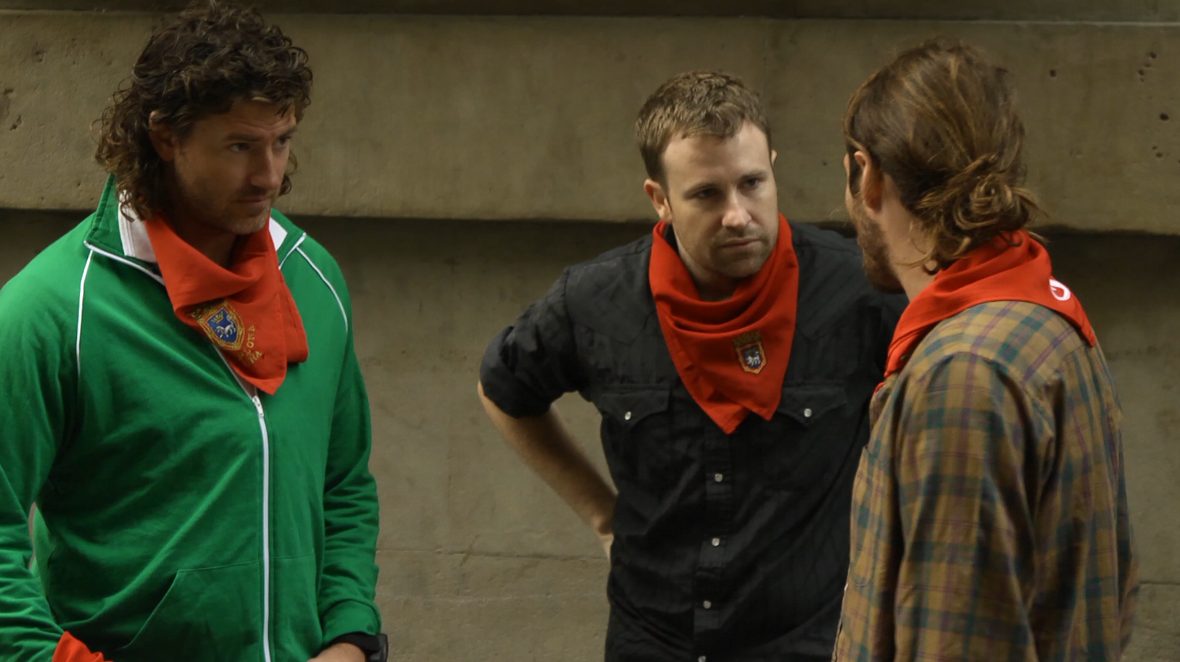
Chasing Red begins with the death of a runner and asks why anyone would do this. The rest of the film answers through the lives of its runners. Dennis chose that opening on purpose. “Sometimes the run itself can get romanticized, and the reality is that death is always a looming possibility in the run,” he says. “It’s kind of luck that it doesn’t happen more often.”
A runner died in Pamplona on July 10, 2009, the fourth run of that year’s fiesta, gored on the final stretch of the route. It was the first fatal goring in Pamplona since 1995, and it happened in the years Dennis was discovering the run and becoming a runner himself.
“I wanted to make sure that Chasing Red wasn’t necessarily seen as something that glorified the run. In my capacity now as an instructor at the Running of the Bulls, I never want to be seen as encouraging people to run with bulls, because I understand the dangers involved. By starting the film in the way that we did, it allows you to say it very clearly up front.”
Dennis Clancey
That position has not changed. Dennis now teaches first-time runners through Encierro, the company he founded and owns, and Chasing Red does not encourage anyone to run.
Why so much run footage was cut
The crew had cameras along the route every morning and footage of every run from almost every angle, but most of it is not in the film. A run that did not advance the story was cut, however good it looked. And the eight runs had to stay in the order they happened: what happens on the second morning in the film happened on the second morning in Pamplona.
“It would have been easy, I think, as a director to cheat the order in which things happened, but we stayed true to what happened each day and told a true and accurate story of the Fiesta.”
Dennis Clancey
One day with David
That rule meant some runners got very little screen time. On the second run the cameras followed David Ubeda down Calle Estafeta. “It was a beautiful run, nearly the entire length of Calle Estafeta,” Dennis says. That run carries David’s part of the story. He left the fiesta after about the third run, so the film has one day with him.
The sixth run: when the plan changed
By the sixth morning, the story was not going to plan.
“On the sixth run, I felt the production was coming to a bit of a crisis point, because certain story points we wanted to hit weren’t necessarily happening within the timeline that we had wanted, but other things unexpectedly did work quite well.”
Dennis Clancey
One of those was Josiah. On his third or fourth run he got very close to the horns of a bull, which the filmmakers counted as a success for his story. Having done well in Mercaderes and the Town Hall square, he was moved for the sixth run to a new part of the route: La Curva, the sharp turn into Estafeta, which he studied and ran under the guidance of Angus Ritchie, a Scottish runner. Most of the cameras went with him that morning. Encierro explains that corner in La Curva de Estafeta.
Dennis, meanwhile, had spent the fiesta chasing one particular run: leading the bulls from the top of Santo Domingo, through the Town Hall square and Mercaderes, and on to Estafeta. On the sixth morning, with most of the cameras at La Curva, he went back down the route and finally made that run, several parts of the route stitched into a single run by a single runner. It is one of the central runs of the film, and it came on the day the production felt closest to crisis. The sections of the street that run passes through are mapped in Encierro’s encierro route guide.
The ending that was planned: Bill Hillmann in Cuéllar
The film was meant to end with Bill Hillmann. “Bill continued to run in various towns in Spain, and I thought it would be great to capture him as the character who continues to run,” Dennis says. Both men are still runners today.
Dennis went with Bill to Cuéllar, a town in Segovia that claims the oldest bull run in Spain. There, the bulls are driven in from the countryside by riders before they run through the streets. The scene was never filmed as planned: someone in the town objected to where the crew intended to film it.
Dennis tried again. He filmed additional interviews with Bill in Chicago and made a couple of attempts to make him the last part of the documentary, but the problems in Cuéllar, which no one could have planned for, worked against it. The other places the film went are in Where we filmed Chasing Red, and what the encierro is beyond Pamplona is in The encierro: what the running of the bulls really is.
The ending the film has: the Portal Nuevo
Without Cuéllar, the film found a different last scene, and it returns to the title. Chasing Red ends with the explanation of the term itself, as the camera pans over the city and Dennis walks through the Portal Nuevo, one of the gates in Pamplona’s old city walls. A film that opens on why someone would run closes on what the runners are chasing.
What the edit changed
Some of the story was found only in the edit room, by Brian Moghari, who shot camera in 2012 and then edited the film.
“There were a number of decisions that came in the process of the edit. Brian was watching everything clip by clip and constructing. We already had a broad concept of what we wanted to do with various scenes, but in a lot of cases, he would see something in the footage that was best to involve. A couple of scenes were inspired by things that he recognized in the footage that we had, and knew would advance the story.”
Dennis Clancey
How the story evolved, year by year
- 2007: Dennis Clancey’s first fiesta in Pamplona. The project is The Pamplona Project, with no fixed story.
- 2007 to 2009: study of documentaries, from the Maysles brothers to Errol Morris.
- 2009: a fiesta spent running and living it rather than filming. A runner dies in Pamplona on July 10.
- 2011: a teaser shot with college friends as runners; the title Chasing Red exists; the idea of intertwined runners takes shape.
- 2012: principal filming over the eight runs of San Fermín, in order. The sixth run changes the story.
- After 2012: Cuéllar falls through as an ending; additional interviews with Bill Hillmann in Chicago; the edit with Brian Moghari settles the final shape.
- 2015: Chasing Red is released, later distributed by Magnolia Pictures.
Where to see the result
You can watch Chasing Red free on The Roku Channel and Hoopla, or rent or buy it on the major platforms.
Questions people ask
What was Chasing Red originally called?
The Pamplona Project. It was a working title used for years, because the story had not been found yet. The title Chasing Red existed by the time a teaser was shot in 2011.
Why does Chasing Red open with a death?
So the film could not be read as glorifying the run. Dennis Clancey wanted the danger stated up front, and a runner had died in Pamplona in 2009, in the years he was becoming a runner.
Were the runs in Chasing Red shown in the order they happened?
Yes. The film follows the eight runs of San Fermín 2012 in their real order. The filmmakers chose not to rearrange events for the story, which is why much of the run footage was cut.
Why is David Ubeda in only part of the film?
He left the fiesta after about the third run. The film follows his run down Calle Estafeta on the second morning, which carries his part of the story.
How was the ending of Chasing Red supposed to go?
It was planned to end with Bill Hillmann running in Cuéllar, in Segovia. A local objection to where the crew wanted to film stopped the scene, and the film ends instead with the meaning of the title and Dennis Clancey walking through the Portal Nuevo in Pamplona.
Sources
- Dennis Clancey, interview with Chasing Red, October 23, 2026.
- sanfermin.com, “Death at the running of the bulls” (San Fermín 2009, fourth run, July 10, 2009).
- NBC News and the Associated Press, “Pamplona sees first goring death since ’95,” July 2009.
- Wikipedia, “Chasing Red” (editor and crew credits); “Enron: The Smartest Guys in the Room”; “Salesman (1969 film)”; “The Thin Blue Line (1988 film)”; “Dear Zachary: A Letter to a Son About His Father”; “Koyaanisqatsi.”
- Free Malaysia Today (AFP), “‘Buffalo’ Bill Hillmann gives tip on running with bulls in Pamplona,” July 7, 2018 (Hillmann’s first run, 2005).
- The Local Spain, February 16, 2015 (Angus Ritchie, Scottish Pamplona runner).
- spain.info, “Encierros de Cuéllar” (Cuéllar’s claim and how its encierro is run).
- encierro.com, route guides for the encierro route, Calle Estafeta and La Curva.